

Payout Calendar: Coupons, Dividends, Reinvestment & Tax
Firewire Analytics Payout Calendar consolidates confirmed and forecasted bond coupon payments, stock dividend payouts, and bond principal amortizations. The system visualizes monthly cash flows, models compound interest from regular reinvestment, and applies 2025 progressive personal income tax rules.
- Monthly Matrix: an interactive "year × month" grid detailing nominal income alongside reinvestment compounding.
- Compound Interest: reinvestment is modeled using the weighted average yield of the investor's current portfolio assets.
- Progressive Tax: net income ("take-home") accounts for the 2025 multi-tier PIT scale and cumulative income exceeding 2.4M RUB.
- Bento Grid Widgets: the matrix and payout structure are available as modular cards in the Bento Grid dashboard.
1. Interface Overview and Core Modules
The Payout Calendar section consists of three tightly integrated analytical components:
- Summary Matrix (CouponCalendarMatrix): a calendar heatmap organized by year and month. Cells with significant payouts are highlighted with contrast background shades, enabling immediate spotting of peak and trough income periods. The footer displays total scheduled cash flow and compounded wealth projections.
- Payout Structure (PayoutStructureCard): a donut chart displaying the breakdown of cash flows across fixed and floating coupons, dividend payments, and partial bond redemptions (amortization).
- Chronological Ledger (CouponHistoryTable): a detailed table filterable by broker accounts, date ranges, and payment statuses ("Paid", "Scheduled"), complete with estimated tax withholdings for every event.
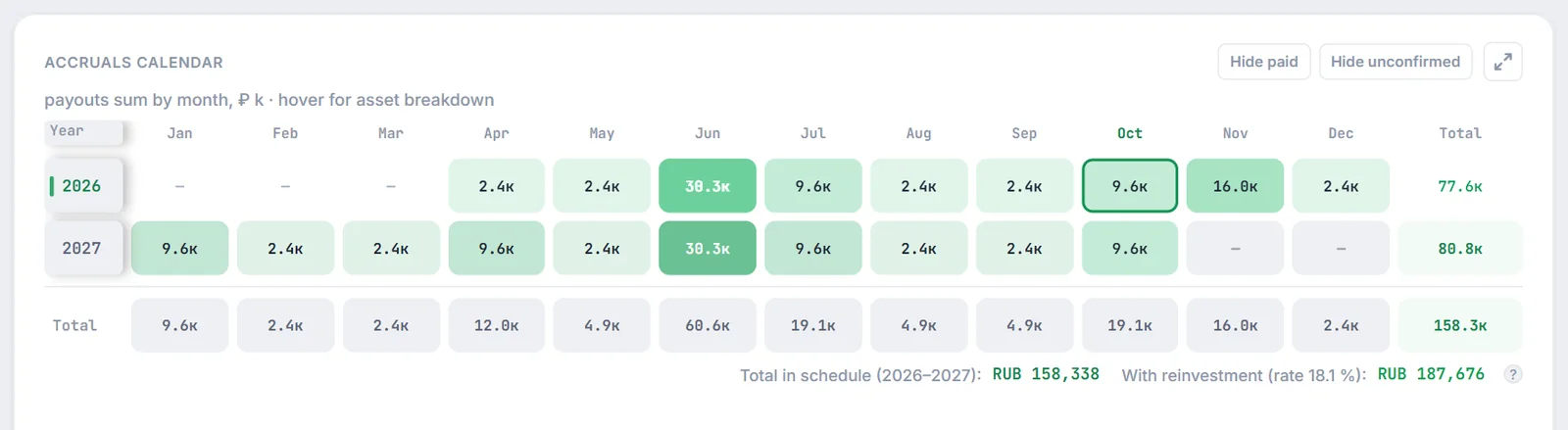
2. Reinvestment Model and Compound Interest
When engineering long-term wealth, the difference between withdrawing income and systematically reinvesting it is paramount. Firewire computes projected portfolio values using compound interest with monthly capitalization.
The reinvestment rate $R_{\text{avg}}$ represents the weighted average yield of the investor's current active portfolio, calculated from bond yields to maturity (YTM) and stock dividend yields:
where $w_k$ denotes the weight of asset $k$ in total portfolio value, and $Y_k$ is the annual yield of that asset.
Future value compounded across schedule months $t$ from $1$ to horizon $N$ is expressed as:
where $C_t$ is total cash flow received in month $t$ (coupons + dividends), and $N$ is the total forecast horizon. In the user interface, the difference between nominal cash and compounded value is styled with a positive performance badge.
3. Tax Accounting and the 2025 Progressive Tax Scale
Effective January 1, 2025, progressive personal income tax rules apply to passive investment yields (coupons and dividends), tiered based on cumulative annual earnings.
Firewire tracks cumulative earnings from January 1 of the active year. Tax withholding for each payment $C_t$ is calculated via differential taxation:
where $B_t$ is the accumulated taxable base of preceding payments in the current calendar year, and $\text{PIT}(X)$ is the progressive tax function:
- Up to 2.4M RUB/year: 13% tax rate;
- 2.4M RUB to 5.0M RUB: 15% rate on the excess;
- 5.0M RUB to 20M RUB: 18% rate on the excess;
- 20M RUB to 50M RUB: 20% rate;
- Above 50M RUB: 22% rate.
The table displays actual expected tax deductions, while net cash flow is computed as $C_t - \text{Tax}_t$. For full mathematical methodology, review Tax Cash Flow Accounting.
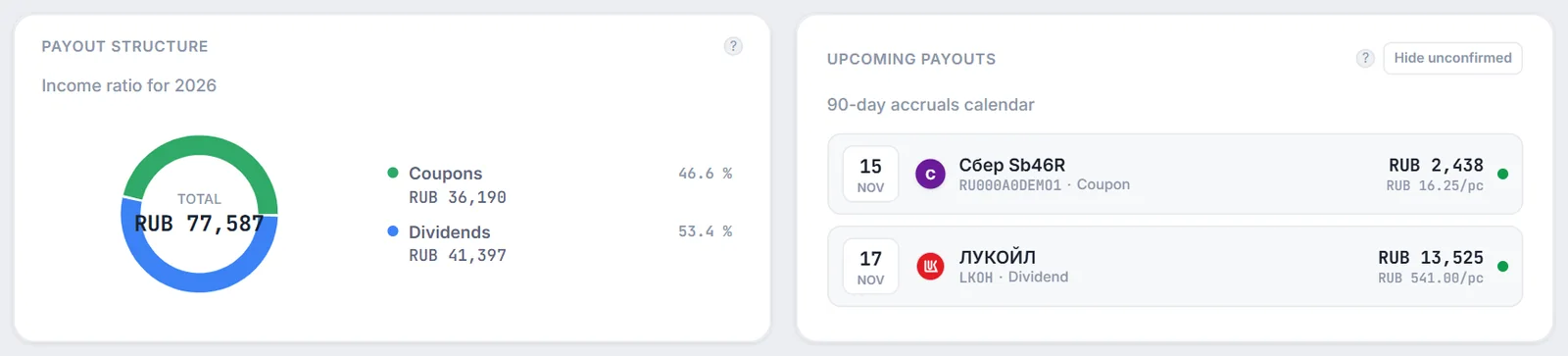
4. Bento Grid Dashboard Integration
Calendar modules are engineered as modular blocks for the custom Bento Grid dashboard:
- Payout Matrix Widget (coupons_matrix): height-optimized with flex-wrapped summary cards to avoid internal scrollbars even across 3-year forecasting periods.
- Structure Widget (payout_structure): locked at a constant span ratio ($span = 18$), ensuring stability for the Recharts responsive pie chart.
- Public Sharing: when sharing portfolio views (portfolio sharing) with masked balances, absolute monetary amounts are concealed while relative timelines and structural percentages remain intact.
5. Data Ingestion and Precision
The payment schedule syncs continuously with exchange protocols and official issuer disclosures:
- Bond Coupons: exact coupon dates, rates, and accrued interest sync directly from MOEX ISS and broker connections (BCS, T-Investments, Finam, Sber).
- Floating Rate Bonds: for floating coupons pegged to the central bank key rate or RUONIA, Firewire projects payouts based on active benchmark rates plus issuer spreads.
- Principal Amortization: partial redemptions are highlighted separately and excluded from the PIT tax base, as principal return does not constitute taxable income.
- Stock Dividends: records incorporate confirmed dividend declarations from corporate boards and shareholder meetings with T-1 record dates.
6. Frequently Asked Questions (FAQ)
Are taxes accounted for if payouts arrive in tax-advantaged accounts (IIS)?
For Type A and IIS-3 accounts, brokers withhold taxes at source upon payment, but investors can claim deductions or refunds upon meeting maturity terms. Read more in IIS Tax Benefits.
Why does the reinvestment rate fluctuate?
The reinvestment rate dynamically tracks the portfolio's weighted average yield. When you execute new trades, receive principal redemptions, or asset prices adjust, the rate recalibrates automatically.
How can I export my payment schedule to Excel or mobile calendars?
Click the "Export" button in the upper right corner of the calendar. You can export to Excel (.xlsx), CSV, or download an .ics file for synchronization with Apple Calendar, Google Calendar, and Outlook (see exporting reports).
What happens if I sell some of my holdings?
The calendar immediately recomputes future payouts based on your updated active position sizes. Historic payments already received remain unchanged.